


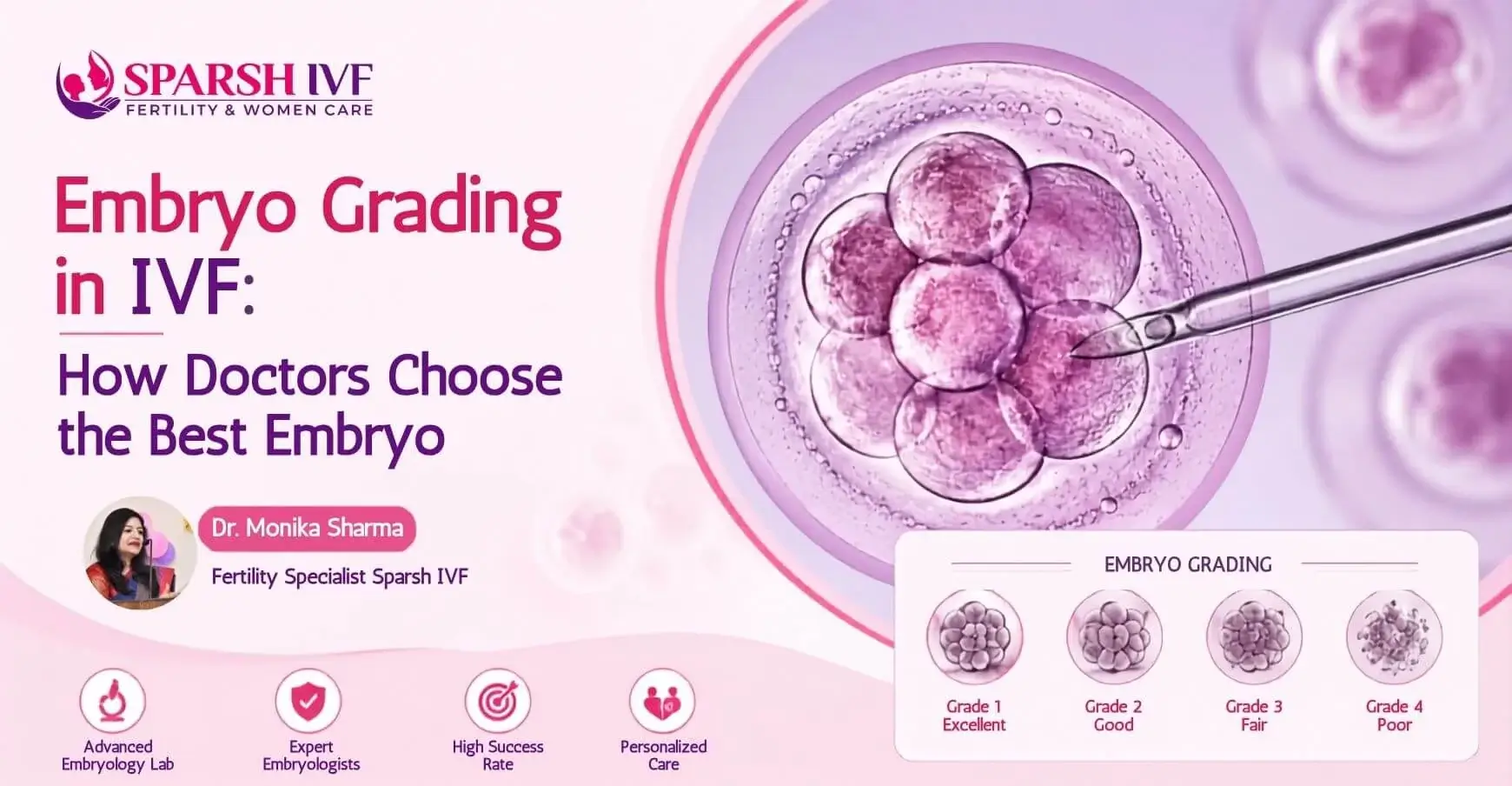
Embryo Grading in IVF: A Complete Guide
Every couple who begins an IVF cycle asks the same question after egg retrieval: “How are our embryos doing?” The answer usually comes in the form of a grade — a letter or number that embryologists use to describe how an embryo looks under the microscope. At Sparsh IVF, a leading Fertility Centre in India, we believe patients deserve to understand this process in plain language, not just lab jargon.
In this guide, Dr. Monika Sharma, who brings over 25 years of experience in reproductive medicine, breaks down what embryo grading means, how embryologists arrive at a grade, and why grading is only one part of the bigger picture when you’re working with skilled Fertility Doctors in India.
What Is Embryo Grading in IVF?
Embryo grading is a visual assessment system embryologists use to evaluate embryo quality before a fresh or frozen transfer. Trained embryologists examine embryos under a high-powered microscope at specific time points after fertilization and score them based on cell number, symmetry, and fragmentation.
The goal is simple: identify which embryos have the highest likelihood of implanting and developing into a healthy pregnancy. Grading does not diagnose genetic health on its own, but it gives our embryology team a reliable, standardized way to compare embryos and choose the best candidate for transfer.
Why Embryo Grading Matters for Your IVF Journey
Choosing the right embryo for transfer directly influences your chances of a successful pregnancy. A well-graded embryo:
- Has a higher probability of implanting in the uterine lining
- Reduces the risk of failed transfers and repeated cycles
- Helps your fertility doctor decide between a fresh or frozen embryo transfer
- Supports single embryo transfer decisions, lowering the risk of multiple pregnancies
At our IVF Center in Rajasthan, every embryo is monitored continuously using advanced culture systems, so our embryologists can track development at every stage rather than relying on a single snapshot.
IVF Treatment at Sparsh IVF India
Day-by-Day: How Embryos Are Graded
Embryo grading happens at different stages of development. Here is how the process typically unfolds.
Day 1: Fertilization Check
On the first day after egg retrieval, embryologists confirm fertilization by checking for two pronuclei, one from the egg and one from the sperm. This step confirms the embryo has fertilized normally.
Day 2–3: Cleavage-Stage Grading
By day two or three, the embryo divides into multiple cells. Embryologists grade cleavage-stage embryos based on:
- Cell number: A healthy day-3 embryo usually has 6 to 8 cells
- Symmetry: Even, uniformly sized cells score higher
- Fragmentation: Less cellular debris indicates better quality
Grades are typically numbered 1 to 4, with grade 1 representing minimal fragmentation and excellent symmetry.
Day 5–6: Blastocyst Grading
Many embryos are cultured further to reach the blastocyst stage, where grading becomes more detailed. Blastocyst grading uses a three-part system, such as 4AA or 3BB, that evaluates:
- Expansion stage (numbered 1 to 6): How much the blastocyst has grown and hatched from its outer shell
- Inner cell mass grade (A, B, or C): The cells that will eventually form the baby
- Trophectoderm grade (A, B, or C): The outer cell layer that will form the placenta
A blastocyst graded 4AA or 5AA is generally considered excellent quality, while lower letter grades still indicate a viable embryo with reasonable transfer potential.
Read more – Blastocyst Culture at Sparsh IVF
Common Embryo Grading Terms Explained
| Term | What It Means |
|---|---|
| Cleavage-stage embryo | Day 2–3 embryo, graded on cell count and symmetry |
| Blastocyst | Day 5–6 embryo with a fluid-filled cavity |
| Inner cell mass (ICM) | Cluster of cells that develops into the fetus |
| Trophectoderm | Outer cell layer that forms the placenta |
| Fragmentation | Small pieces of cellular material that can lower grade |
| Mosaic embryo | Embryo with a mix of normal and abnormal cells, identified through genetic testing rather than grading alone |
Does a Lower Grade Mean No Chance of Pregnancy?
This is one of the most common concerns patients raise, and it deserves a clear answer: no. Embryo grading is a visual tool, not a guarantee. Many pregnancies have resulted from embryos with average or lower grades, and some top-graded embryos do not implant. Grading helps our team prioritize which embryo to transfer first, but factors like uterine receptivity, hormonal balance, and underlying health conditions also play a significant role in outcomes.
This is why we always evaluate grading alongside a patient’s complete clinical picture rather than relying on the grade in isolation.
Embryo Grading vs. Genetic Testing (PGT-A)
Grading and genetic testing answer different questions. Embryo grading assesses how an embryo looks, while Preimplantation Genetic Testing for Aneuploidy (PGT-A) examines whether an embryo has the correct number of chromosomes. A visually excellent embryo can still carry a chromosomal abnormality, and a moderately graded embryo can be chromosomally normal.
For patients with recurrent implantation failure, recurrent miscarriage, or advanced maternal age, we often recommend combining grading with PGT-A for a more complete assessment before transfer.
How Sparsh IVF Approaches Embryo Grading
As a trusted Fertility Centre in India, we combine internationally recognized grading standards with continuous embryo monitoring technology. Our embryology lab tracks embryo development around the clock, which allows our team to select embryos based on both morphology and growth pattern rather than a single point-in-time observation.
Dr. Monika Sharma and her clinical team review every case individually, discussing grading results with patients in clear, understandable terms so you always know what to expect before your embryo transfer.
Finding the Right Fertility Doctors in India
Embryo grading is only as reliable as the lab and the team performing it. When choosing among Fertility Doctors in India, look for a center with:
- A dedicated, climate-controlled embryology lab
- Continuous embryo monitoring systems
- Transparent communication about grading and next steps
- Experienced embryologists working alongside senior fertility specialists
If you’re searching for the best gynaecologist in Udaipur or a dependable IVF Center in Rajasthan, our team at Sparsh IVF is here to guide you through every stage, from your first consultation to embryo transfer and beyond.
Frequently Asked Questions
For blastocysts, grades like 4AA or 4AB are generally considered high quality. For day-3 embryos, a grade 1 or 2 embryo with 6 to 8 cells and minimal fragmentation is considered favorable. However, even lower-graded embryos can result in successful pregnancies.
Yes. Embryo grading reflects appearance, not genetic health. Many patients with lower-graded embryos have gone on to have healthy pregnancies and deliveries.
The number depends on how many eggs are retrieved and how many fertilize successfully. Your embryologist will grade every embryo that develops and share the results with your fertility doctor.
Grading systems follow similar international standards, but consistency depends on the embryologist's training and the lab's monitoring technology. Choosing an experienced IVF Center in Rajasthan helps ensure accurate, consistent grading.
Your fertility specialist will consider grading along with your hormone levels, uterine lining, and overall health to recommend whether a fresh or frozen transfer gives you the best chance of success.
Ready to Start Your Health Journey?
Understanding embryo grading can ease some of the uncertainty during your IVF journey, but the right team makes the biggest difference. With over 25 years of experience, Dr. Monika Sharma and the Sparsh IVF team combine advanced embryology with compassionate, transparent care.
If you’re searching for a trusted Women Health Care Centre in India or looking for the best gynaecologist in Udaipur, book a consultation with Dr. Monika Sharma and the Sparsh IVF team today. Contact us at [email protected], +91-7878305787
Comments are closed