


Call us today at +91-7878305787 or visit our
website to book your appointment!
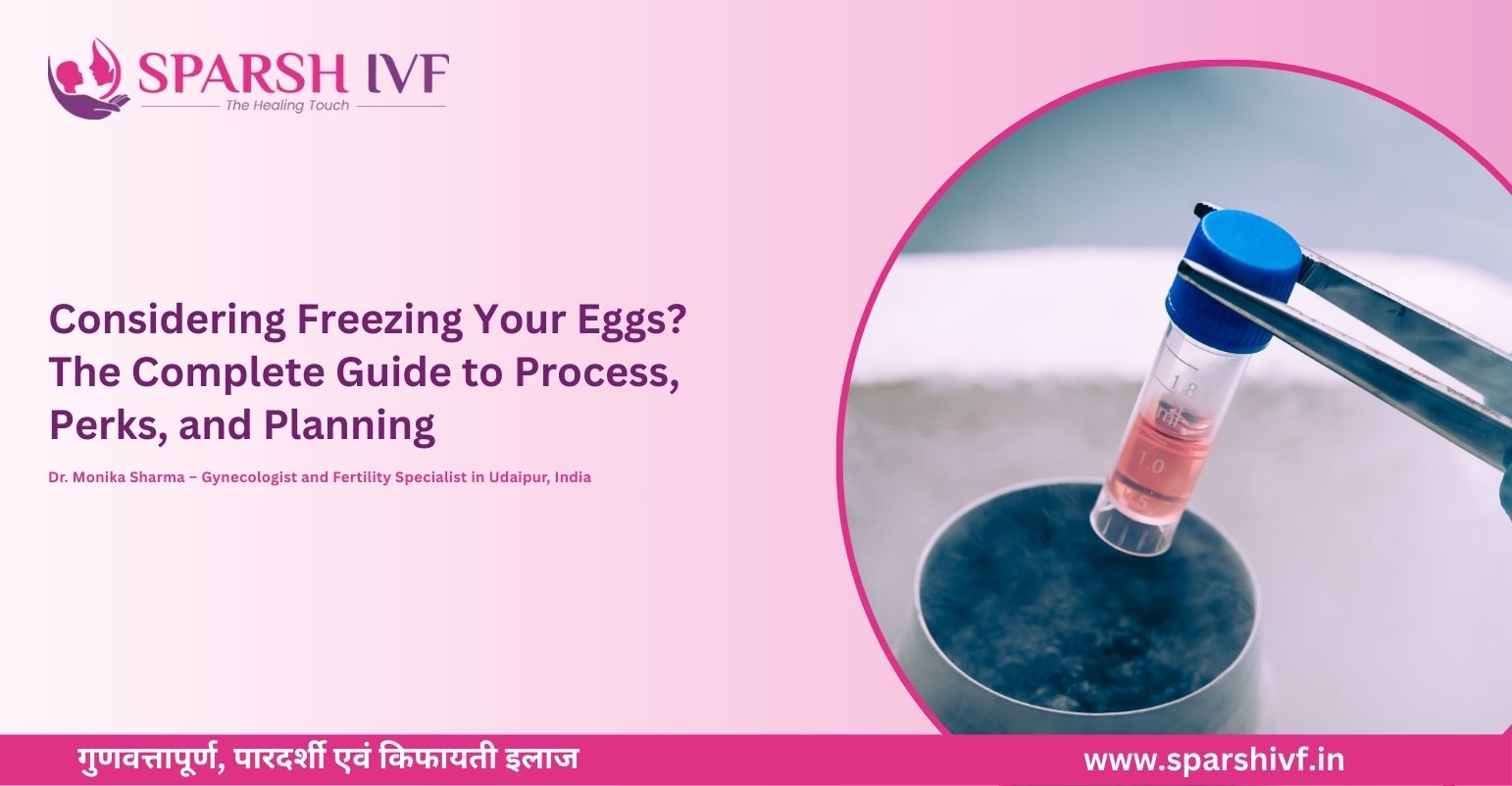
Considering Freezing Your Eggs? The Complete Guide to Process, Perks, and Planning
In today’s fast-paced world, women are navigating career goals, personal development, and
the desire for partnership, often finding that the biological clock doesn’t align perfectly with their life plans.
If you are focused on the present but want to ensure future options for motherhood, egg freezing—or oocyte
cryopreservation—offers a powerful solution.
At SPARSH IVF – Best IVF Hospital in Udaipur, India, we empower women
with knowledge and advanced technology. This is your complete guide to understanding the process, the benefits, and
the planning required for successful egg freezing.
What is Egg Freezing, and Who Should Consider It?
Egg freezing is a process where a woman’s eggs (oocytes) are retrieved, cooled to sub-zero
temperatures, and stored for later use.
Who is the Ideal Candidate?
- Career-Focused Women: Those who want to delay childbearing to focus on professional
advancement. - Lack of Partner: Women who have not yet found a suitable partner but wish to use
their younger, healthier eggs in the future. - Medical Indications: Women facing medical treatments (like chemotherapy or radiation)
that could damage ovarian reserve. - Family Planning: Women with a known risk of premature ovarian failure or early
menopause. - Ethical/Religious Reasons: Couples undergoing IVF who freeze eggs instead of embryos
for ethical reasons.
The Egg Freezing Process: A Step-by-Step Breakdown
The journey to freeze your eggs is very similar to the initial stages of In Vitro Fertilization (IVF). It is a
carefully monitored, personalized process designed to retrieve the maximum number of healthy eggs.
1. Initial Consultation and Assessment
- Ovarian Reserve Testing: We start with blood tests (like measuring Anti-Müllerian
Hormone or AMH) and a transvaginal ultrasound to assess your ovarian reserve—how many eggs you
currently
have and how well you are likely to respond to stimulation. - Personalized Plan: Based on your age and test results, our specialists will tailor a
protocol for medication and monitoring.
2. Ovarian Stimulation (Approx. 10–14 Days)
- Medication: You will be prescribed injectable hormonal medications for about 10–14
days. These drugs stimulate your ovaries to mature multiple egg-containing follicles simultaneously, rather
than just the one dominant egg released during a natural cycle. - Monitoring: You will visit SPARSH IVF frequently for ultrasound scans and blood tests
to track the growth of the follicles. This ensures the eggs are maturing optimally and allows us to adjust
medication dosages precisely.
3. The Retrieval Procedure
- The Trigger Shot: Once the follicles reach the optimal size, a final injection (the
“trigger shot”) is administered to finalize the eggs’ maturation. - Retrieval: Approximately 34–36 hours after the trigger shot, the egg retrieval is
performed.
This is a minor surgical procedure done under mild sedation. Using ultrasound guidance, a fine needle is
passed through the vaginal wall to gently suction the fluid and eggs from the follicles. The procedure
typically takes about 15–30 minutes.
4. Cryopreservation (Freezing)
- Vitrification: The retrieved eggs are immediately taken to our advanced embryology
lab. We
use a rapid-freezing technique called vitrification. This flash-freezing method is crucial as it
prevents
the formation of ice crystals that can damage the delicate egg structure, ensuring high survival rates upon
thawing. - Storage: The frozen eggs are then stored indefinitely in specialized tanks containing
liquid nitrogen.
The Perks of Planning: Why Age Matters
The most significant factor influencing the success of egg freezing is the age of the eggs at the
time of freezing.
| Age at Freezing | Egg Quality | Success Rate Potential |
|---|---|---|
| Early 30s (30-34) | Excellent | High. Eggs are genetically robust. |
| Mid-30s (35-37) | Good to Very Good | Optimal window before decline accelerates. |
| Late 30s (38-40) | Declining | Requires more retrieved eggs for the same chance of success. |
| Over 40 | Lower | Success is significantly reduced; consultation is critical. |
Freezing your eggs while you are younger ensures that when you are ready to conceive—even if you are 40 or older—you
will be using eggs that retain the quality and chromosomal health of your younger self.
Planning Your Egg Freezing Journey
- Success Rates: Success is measured by the number of eggs retrieved and the survival
rate
upon thawing. A typical cycle yields 10–20 eggs, but this varies greatly. Our team will counsel you on your
specific chances based on your AMH and age. - Cost and Duration: The cost covers testing, medications, the retrieval procedure, and
annual
storage fees. While the stimulation and retrieval process takes about 2 weeks, the planning and initial
assessments will require a consultation.
Take Control of Your Future
Egg freezing is a proactive and empowering choice. It is a bridge between your present life and your future
SPARSH IVF, you are choosing one of the best fertility hospitals in Udaipur,
India, equipped with state-of-the-art vitrification technology and experienced specialists dedicated to preserving
your potential.
Ready to discuss your personalized egg freezing plan?
Contact SPARSH IVF today to schedule a confidential consultation and take the first step toward securing your reproductive future.
Comments are closed